-2.png)
How Automatic LPG Changeover Prevents Commercial Kitchen Downtime
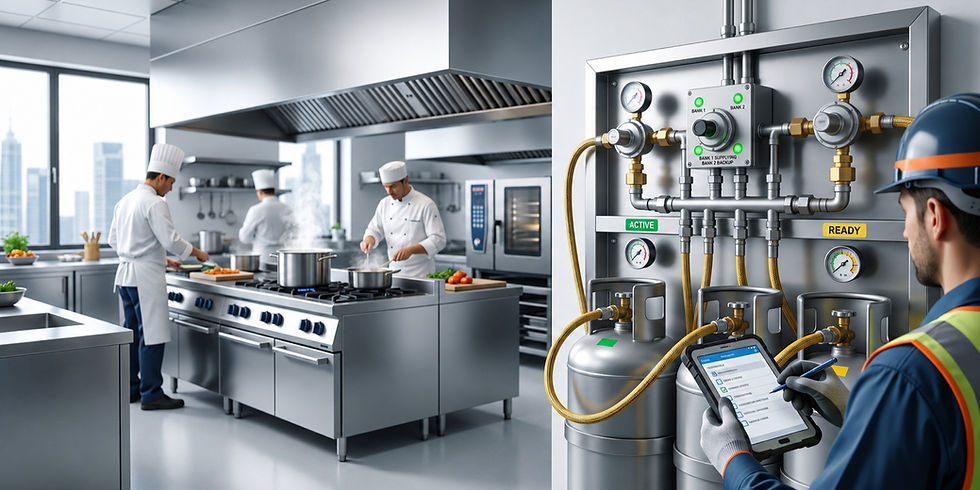
A restaurant can survive a busy dinner service with a few minor delays but running out of LPG is not one of them. When the gas supply stops, burners go out, cooking slows down, orders are delayed, and customers notice.
For restaurants that depend heavily on LPG, an automatic LPG changeover system provides a practical way to maintain a continuous gas supply by switching between LPG cylinder banks when the active supply is depleted.
In this guide, we'll explain how an automatic changeover system works, why it matters for commercial kitchens, what benefits it provides, and how to choose the right system for your restaurant.
An automatic LPG changeover system connects two LPG cylinder banks and automatically switches gas supply from the primary bank to the reserve bank when the primary supply reaches its changeover pressure. This helps reduce interruptions and gives staff time to replace empty cylinders without stopping kitchen operations.
What Is an Automatic LPG Changeover System?
An automatic LPG changeover system is a pressure-controlled arrangement that allows a commercial kitchen to draw LPG from one cylinder bank while keeping another bank available as a reserve.
A typical arrangement looks like this:
Primary LPG cylinders → Changeover system → Regulator → Gas piping → Kitchen appliances
Reserve LPG cylinders → Changeover system → Regulator → Gas piping → Kitchen appliances
When the primary cylinder bank becomes depleted, the system automatically changes over to the reserve bank.
Instead of a kitchen employee having to notice that the LPG supply is running low and manually switch cylinders, the system handles the transition automatically.
This is why an Automatic LPG changeover Singapore solution can be particularly useful for restaurants with continuous or high-volume cooking operations.
How Does an Automatic LPG Changeover System Work?
The principle is relatively straightforward.
1. Two LPG Banks Are Connected
The system typically has:
A primary cylinder bank
A reserve cylinder bank
Changeover equipment
Pressure regulation
Downstream gas piping
The primary bank supplies LPG to the kitchen during normal operation.
The reserve bank remains available for use when the primary supply is depleted.
2. The System Monitors Pressure
The changeover system monitors the pressure available from the active LPG bank.
As the cylinders become depleted, the pressure available from that side eventually falls.
3. The System Changes Supply
When the primary bank reaches the changeover point, the system switches the gas supply to the reserve bank.
The kitchen can continue receiving LPG without requiring staff to manually change the supply at that exact moment.
4. Staff Replaces the Empty Cylinders
Once the system has switched to the reserve side, staff can arrange for the depleted cylinders to be replaced.
The previously empty bank then becomes the reserve for the next cycle.
This creates a simple operating pattern:
Bank A supplies gas → Bank A becomes depleted → System changes to Bank B → Bank A is replaced → Bank A becomes the reserve.
Why Is LPG Changeover Important for Commercial Kitchens?
For a restaurant, LPG isn't just another utility.
It's directly connected to food production.
If a restaurant uses LPG for:
Wok burners
Ranges
Fryers
Grills
Ovens
Steamers
Cooking ranges
then a gas interruption can affect multiple parts of the kitchen.
During a quiet afternoon, a short interruption might be manageable.
During the dinner rush, it can become a major operational problem.
That's where an LPG changeover system for restaurants can provide a significant advantage.
How Automatic LPG Changeover Prevents Commercial Kitchen Downtime
1. Reduces Interruptions When a Cylinder Bank Runs Out
The biggest benefit is continuity.
Without automatic changeover, staff may need to monitor the LPG supply and manually switch between cylinder banks.
If the change isn't made quickly enough, appliances can lose their gas supply.
Automatic changeover reduces reliance on manual intervention.
2. Gives Staff More Time to Replace Cylinders
The changeover system does not mean cylinders never need replacing.
Instead, it changes when the replacement happens.
Once the system moves to the reserve bank, staff have an opportunity to replace the depleted cylinders while the kitchen continues operating.
This is particularly useful during busy service periods.
3. Reduces the Risk of Running Out of Gas During Peak Hours
Restaurant LPG consumption can change significantly depending on demand.
For example, a kitchen may use much more LPG during:
Lunch service
Dinner service
Weekends
Public holidays
Large catering orders
Having a reserve LPG bank can provide additional operational flexibility.
4. Reduces Manual Monitoring
Restaurant employees already have plenty to manage.
They are dealing with:
Orders
Food preparation
Cooking
Cleaning
Inventory
Customers
Deliveries
Having staff constantly monitor LPG pressure isn't an efficient use of their time.
An Automatic gas changeover system Singapore restaurants use can reduce the need for constant manual monitoring of the active cylinder bank.
Automatic vs Manual LPG Changeover
What is the difference?
Feature | Manual Changeover | Automatic Changeover |
Supply switching | Manual | Automatic |
Staff monitoring | Higher | Lower |
Risk of service interruption | Higher | Lower |
Reserve supply | Depends on setup | Designed into system |
Convenience | Basic | Higher |
Suitable for high-demand kitchens | Less convenient | Often more suitable |
Manual systems can still work for smaller or lower-demand applications.
However, restaurants with high LPG consumption may benefit from an automatic arrangement.
Benefits of Automatic LPG Changeover for Restaurants in Singapore
Continuous LPG Availability
The primary advantage is maintaining gas availability when one cylinder bank becomes depleted.
Better Kitchen Productivity
Staff can focus on cooking and service rather than manually managing the LPG supply.
Reduced Operational Disruption
A properly designed system reduces the likelihood that an empty cylinder bank will immediately interrupt cooking operations.
Better Supply Management
Restaurant operators can establish a more organised cylinder replacement routine.
Useful for High-Consumption Kitchens
Restaurants with multiple LPG appliances can benefit from having a reserve supply available.
Greater Convenience
Automatic switching reduces the need for staff to perform a manual changeover at inconvenient times.
Who Should Consider an Automatic LPG Changeover System?
An automatic changeover system can be particularly useful for:
Restaurants
Restaurants with several LPG-powered cooking appliances may benefit from continuous supply.
Central Kitchens
Large-scale food preparation facilities can have significant and relatively consistent LPG demand.
Hotels
Hotel kitchens may operate for long hours and require dependable cooking fuel.
Catering Businesses
Catering operations can experience sudden increases in LPG demand during large events.
Food Manufacturing Operations
Businesses that use LPG continuously for food production may need a more reliable gas supply arrangement.
How to Choose an LPG Changeover System for a Commercial Kitchen
Choosing the right Commercial LPG changeover system involves more than simply selecting a product based on cylinder capacity.
Consider these factors.
1. Calculate Your LPG Demand
Start by identifying all LPG appliances.
For example:
8 wok burners
2 fryers
2 ovens
1 grill
Find the LPG input rating for each appliance and determine the expected simultaneous demand.
Your LPG professional can use this information to determine the required system capacity.
2. Consider Your Cylinder Configuration
Determine:
Number of cylinders per bank
Cylinder capacity
Total LPG storage
Manifold configuration
Expected operating duration
A restaurant with high consumption may need a different arrangement from a small café.
3. Check Required Gas Pressure
The changeover system must work with the LPG installation's pressure requirements.
The overall system may include:
Cylinders → Changeover → Pressure regulation → Piping → Appliances
The regulator and downstream piping must also be appropriately sized.
4. Consider Peak Demand
Don't design the system around your quietest operating period.
Consider your busiest service.
For example, if your restaurant operates normally with four burners but may use ten appliances during weekend dinner service, the LPG system should be assessed for the higher demand.
5. Think About Future Expansion
Are you planning to:
Add another cooking line?
Install additional ovens?
Expand your menu?
Increase catering?
Open another kitchen area?
Discuss these plans before finalising the LPG system.
Signs That Your Restaurant May Need Automatic Changeover
You may want to consider an automatic system if:
LPG cylinders frequently run out during service
Staff manually change cylinders
Kitchen operations depend heavily on LPG
Your restaurant operates long hours
You use multiple LPG cylinders
Gas demand is high
You have experienced unexpected interruptions
Your kitchen has multiple LPG appliances
A changeover system isn't necessarily required for every restaurant, but it can be valuable where continuity of supply is important.
Does Automatic Changeover Mean the LPG Supply Is Unlimited?
No.
This is an important distinction.
An automatic changeover system doesn't create additional LPG.
It simply manages the available supply more effectively.
For example:
Primary bank = 4 cylinders
Reserve bank = 4 cylinders
When the primary bank is depleted, the system changes over to the reserve bank.
The restaurant still needs to replace the depleted cylinders.
If both banks eventually become empty, the LPG supply will stop.
Therefore, proper cylinder planning and timely replacement remain essential.
How to Prevent LPG Supply Problems in Your Restaurant
An automatic changeover system works best when combined with good LPG management.
Monitor Cylinder Inventory
Know how many full and empty cylinders you have.
Establish a Replacement Schedule
Don't wait until both cylinder banks are nearly empty before arranging replacement.
Understand Your Consumption
Track LPG usage over several weeks.
This can help identify:
Average daily consumption
Peak consumption
Busy periods
Unusual increases
Maintain the System
Regularly inspect the changeover equipment, regulators, valves, connections and associated piping.
Train Staff
Employees should understand:
Which bank is active
Which bank is reserve
How to identify a changeover
When to contact the LPG supplier
What to do during a suspected gas leak
Automatic LPG Changeover and Safety
Continuity is important, but safety comes first.
An automatic changeover system should be part of a properly designed LPG installation.
The overall system may include:
LPG cylinders
Manifold
Changeover equipment
Pressure regulators
Shut-off valves
Gas piping
Gas leak detection where required
Emergency shut-off arrangements
Appropriate fire-safety equipment
In Singapore, commercial LPG installations are subject to applicable SCDF requirements. The current Fire Code covers LPG cylinder installations, including requirements relating to cylinder locations, manifolds, regulators, emergency shut-off arrangements and safety provisions.
Gas installation work should also be carried out and assessed by appropriately qualified professionals. EMA states that commercial premises must engage a Licensed Gas Service Worker or Professional Engineer to inspect and certify that a gas installation is safe for use.
Common Mistakes to Avoid
Choosing a System Based Only on Price
The cheapest system isn't necessarily the most suitable.
Consider capacity, compatibility, installation requirements and safety.
Ignoring Peak LPG Demand
A system should be assessed against expected maximum demand rather than only average consumption.
Using an Undersized Regulator
An incorrectly sized regulator can affect downstream gas pressure and appliance performance.
Forgetting the Reserve Bank
Automatic changeover only provides continuity if there is a usable reserve supply.
Delaying Cylinder Replacement
Once the reserve bank becomes active, arrange replacement of the depleted bank promptly.
Installing Without Professional Assessment
Commercial LPG systems should be properly designed and installed rather than assembled based on assumptions.
A Simple Example
Imagine a restaurant operates with two LPG cylinder banks:
Bank A: 6 cylinders Bank B: 6 cylinders
During normal operation:
Bank A → Changeover system → Kitchen
Bank B remains available as the reserve.
When Bank A becomes depleted:
Bank B → Changeover system → Kitchen
The restaurant continues receiving LPG while staff arrange replacement of Bank A.
Once Bank A is replenished, it becomes the reserve again.
This simple operating cycle can significantly reduce the chance of an LPG interruption occurring at the worst possible time.
Frequently Asked Questions
How does an automatic LPG changeover system work?
An automatic LPG changeover system connects primary and reserve LPG cylinder banks. When the active bank reaches its changeover condition, the system automatically switches the gas supply to the reserve bank.
What are the benefits of automatic LPG changeover for restaurants in Singapore?
The main benefits include reduced manual intervention, better supply continuity, easier cylinder replacement planning and reduced risk of interruptions when the active cylinder bank becomes depleted.
Is automatic LPG changeover necessary for every restaurant?
No. Smaller restaurants with lower LPG demand may use simpler arrangements. The appropriate system depends on LPG consumption, operating hours, appliance load and cylinder configuration.
Can automatic LPG changeover prevent a restaurant from running out of LPG?
It can reduce interruptions caused by an empty primary cylinder bank, but it cannot prevent the entire LPG supply from running out. The reserve cylinders must also be replenished.
How do I choose an LPG changeover system for a commercial kitchen?
Consider LPG demand, appliance load, cylinder capacity, number of cylinders per bank, required gas pressure, peak usage and future expansion. A qualified LPG professional should assess the complete system.
Does automatic changeover improve LPG efficiency?
The main purpose is supply continuity rather than directly reducing LPG consumption. However, better supply management can help restaurants monitor usage and manage cylinder replacement more effectively.
What happens when the primary LPG cylinder bank becomes empty?
The changeover system switches the gas supply to the reserve bank according to its design. Staff can then arrange replacement of the depleted cylinders.
How often should an LPG changeover system be inspected?
Inspection and maintenance should follow the equipment manufacturer's recommendations and applicable requirements. The entire LPG installation should also be periodically assessed for leaks, corrosion, damage and other issues.
Conclusion
For a restaurant that relies heavily on LPG, an interruption in gas supply can quickly become an interruption in business. An Automatic LPG changeover system helps reduce this risk by automatically transferring the gas supply from a depleted primary cylinder bank to a reserve bank.
The result is a more convenient and dependable LPG supply arrangement, giving restaurant staff more time to replace empty cylinders without having to stop kitchen operations immediately.
However, the changeover system is only one part of the solution. Correct cylinder sizing, adequate gas capacity, appropriate regulators, proper installation and regular maintenance are equally important.
If you're planning a new commercial kitchen or looking to upgrade your existing LPG system, Jia Liang LPG can help you determine a suitable LPG supply solution for your restaurant.
Contact Us today to discuss your commercial LPG requirements and keep your kitchen running with greater confidence.


Comments