-2.png)
50kg LPG Cylinder vs Multiple Small Cylinders: Which Is Better?
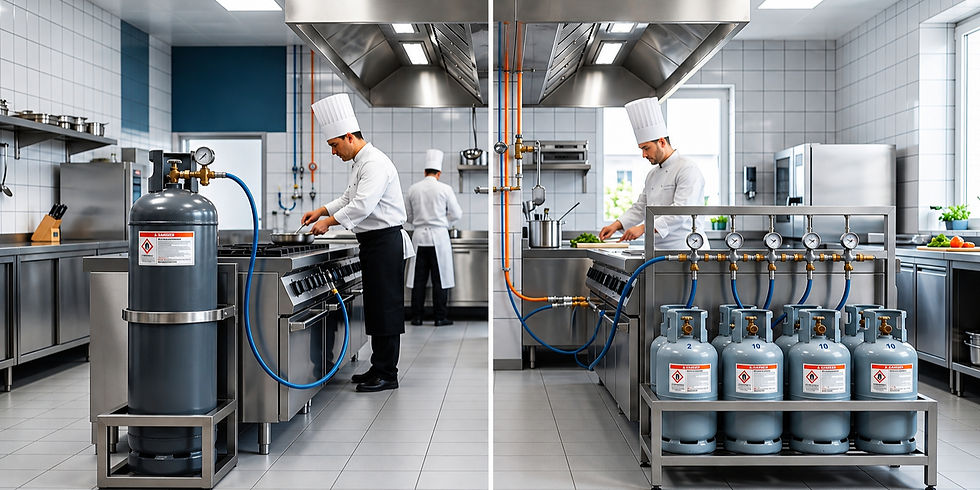
Choosing the right LPG cylinder can affect your restaurant's kitchen efficiency, storage requirements, delivery frequency, and operating costs. But is a 50kg LPG cylinder actually better than using several smaller cylinders?
For restaurants, cafés, catering businesses, and other commercial kitchens in Singapore, the answer depends on LPG consumption, available storage space, kitchen demand, installation requirements, and supply arrangements. This guide compares both options to help LPG buyers make a practical decision.
Quick Answer:
For a high-consumption commercial kitchen, a 50kg LPG cylinder setup can be more practical because fewer cylinders may be needed to provide the required LPG capacity. This can simplify cylinder management and potentially reduce the frequency of replacements.
However, multiple smaller cylinders can be more suitable for businesses with lower LPG consumption or limited requirements.
The better option depends on:
Daily LPG consumption
Kitchen size
Number of gas appliances
Available cylinder storage space
Delivery requirements
LPG installation design
Safety and regulatory requirements
Business operating hours
There is no one-size-fits-all answer.
What Is a 50kg LPG Cylinder?
A 50kg LPG cylinder is a larger-capacity LPG cylinder commonly used for commercial applications where businesses require a steady supply of cooking gas.
Compared with smaller cylinders, a 50kg cylinder stores more LPG in a single unit. This can make it useful for restaurants and commercial kitchens with relatively high and consistent gas consumption.
For example, instead of managing several smaller cylinders individually, a commercial kitchen may use a smaller number of larger cylinders connected through an appropriate manifold system.
In Singapore, LPG cylinder installations for commercial premises must comply with applicable fire-safety requirements. The Singapore Civil Defence Force (SCDF) Fire Code specifies requirements covering cylinder location, capacity, ventilation, separation distances, manifold systems, and other safety provisions.
50kg LPG Cylinder vs Multiple Small Cylinders: Key Differences
Before choosing a cylinder configuration, it helps to compare the two options based on practical factors.
Factor | 50kg LPG Cylinder | Multiple Small Cylinders |
LPG capacity per cylinder | Higher | Lower |
Cylinder handling | Fewer units | More units |
Suitable for high consumption | Generally more suitable | May require frequent replacement |
Storage planning | Requires suitable installation | More individual cylinders to manage |
Delivery frequency | Potentially lower | Potentially higher |
Commercial kitchen use | Well suited to higher demand | Suitable for lower/moderate demand |
Installation | May require manifold system | Depends on configuration |
Space requirements | Depends on approved installation | Depends on number of cylinders |
The important point is that cylinder capacity alone should not determine your decision. Your kitchen's actual LPG consumption and approved installation design matter more.
Why Choose a 50kg LPG Cylinder?
There are several potential benefits of using a 50kg LPG cylinder in Singapore, particularly for businesses with regular LPG demand.
1. Higher LPG Capacity Per Cylinder
A 50kg cylinder contains considerably more LPG than common smaller commercial cylinders.
For a restaurant that consumes LPG continuously throughout the day, having larger-capacity cylinders can make supply management easier.
Instead of repeatedly replacing smaller cylinders, the business can manage a larger quantity of LPG through a suitable installation.
2. Fewer Cylinders to Manage
If your LPG demand is high, using several small cylinders can mean more individual cylinders to monitor, replace, and organise.
A larger-cylinder configuration can reduce the number of individual units required for a given storage capacity.
This can make cylinder management simpler for restaurant staff.
3. Better Suited to High-Consumption Kitchens
Restaurants with several gas burners, woks, ovens, fryers, or other LPG-powered appliances may have significant daily demand.
For these businesses, a larger-capacity LPG setup can provide a more practical solution than relying on frequent small-cylinder replacements.
4. Easier Supply Planning
Businesses can monitor consumption and plan deliveries around their actual usage.
This is especially useful for kitchens where LPG is essential for daily operations.
However, the right supply schedule depends on your consumption, cylinder configuration, and supplier arrangement.
When Are Multiple Small LPG Cylinders Better?
A large LPG cylinder vs small cylinders comparison isn't automatically won by the larger cylinder.
Smaller cylinders can make sense in certain situations.
Small Cafés and Low-Consumption Businesses
A café with limited gas cooking may not need a large-capacity installation.
If LPG consumption is relatively low, smaller cylinders may be sufficient for daily operations.
Businesses With Lower LPG Demand
If the kitchen only uses gas for one or two appliances, investing in a larger setup may not provide a meaningful advantage.
Limited Installation Requirements
The available space and approved installation arrangement can influence which cylinder configuration is practical.
Before changing cylinder sizes, businesses should consult an authorised LPG professional and confirm that the proposed installation meets applicable requirements.
Which LPG Cylinder Size Is Best for Commercial Kitchens?
So, which LPG cylinder size is best for commercial kitchens?
The answer depends on the kitchen's consumption rather than simply choosing the largest cylinder available.
Consider the following:
Choose a Larger-Capacity Setup If:
LPG consumption is consistently high
Multiple burners operate throughout the day
The restaurant has long operating hours
LPG is a primary cooking fuel
The business needs a more structured commercial supply system
Consider Smaller Cylinders If:
LPG consumption is relatively low
Only a few appliances use LPG
The business has limited cooking requirements
A larger installation isn't necessary for the kitchen's demand
The best configuration should balance capacity, safety, convenience, cost, and regulatory compliance.
How LPG Consumption Should Influence Your Decision
Before switching from small cylinders to a 50kg LPG cylinder, calculate how much gas your business actually consumes.
Start by reviewing your LPG purchases over the previous three to six months.
Record:
Number of cylinders purchased
Cylinder capacity
Replacement frequency
Monthly LPG expenditure
Number of operating days
Average kitchen operating hours
Then calculate your average monthly consumption.
Example
Suppose a restaurant currently uses multiple smaller cylinders and records the following monthly consumption:
Month 1: 280kg
Month 2: 300kg
Month 3: 290kg
Average monthly consumption:
(280 + 300 + 290) ÷ 3 = 290kg
This gives the restaurant a useful starting point when discussing its LPG requirements with a supplier.
The supplier can then assess the appropriate cylinder and manifold configuration based on the kitchen's actual requirements and the applicable installation rules.
Commercial LPG Cylinder Singapore: What Should You Consider?
When searching for a Commercial LPG cylinder Singapore solution, don't compare cylinder prices alone.
Consider the complete supply arrangement.
1. Total LPG Cost
Compare the effective cost of your LPG supply rather than just the advertised cylinder price.
Ask whether the quotation includes:
LPG charges
Delivery
Cylinder-related costs
Installation or service charges
Other applicable fees
2. Delivery Frequency
A restaurant cannot afford to run out of cooking gas during peak service.
Your supplier should be able to provide a delivery schedule that matches your consumption.
3. Storage Space
Larger cylinders require appropriate storage and installation arrangements.
In Singapore, commercial and industrial LPG cylinder installations are generally required to be located outdoors and at ground level, subject to the applicable requirements and approved arrangements.
4. Safety Requirements
LPG cylinder installations need suitable ventilation, safe positioning, and appropriate protective measures.
For example, SCDF requirements include specific separation distances from exits, openings, drains, mechanical air intakes, boundaries, and other features depending on the installation.
This means you should never assume that you can simply replace several small cylinders with 50kg cylinders without checking the installation requirements.
LPG Cylinder Sizes in Singapore: What Buyers Should Know
When comparing LPG cylinder sizes Singapore, buyers should focus on the actual needs of their business.
Cylinder capacity is only one part of the decision.
You also need to consider:
Total LPG quantity
Number of cylinders
Manifold arrangement
Storage location
Ventilation
Fire-safety requirements
Gas demand
Delivery requirements
For example, SCDF's current Fire Code provides specific provisions for eating outlets and commercial installations. For certain outdoor eating-outlet installations, the code allows up to 600kg attached to a single manifold system, with specific cabinet and cylinder limits and separation requirements.
Therefore, the correct cylinder size should always be selected as part of an appropriate and compliant LPG system.
50kg LPG Cylinder: Safety and Installation Considerations
Safety should come before convenience or price.
SCDF requires LPG cylinder installations to meet specific safety conditions. These include requirements relating to:
Ventilation
Cylinder positioning
Emergency shut-off systems
Fire extinguishers
Warning signage
Separation distances
Manifold systems
Approved fittings and components
For outdoor installations, cylinders must be placed on a firm, clean, dry, level base in a well-ventilated location where leaking gas can safely disperse.
SCDF also advises that LPG dealers conduct a five-point safety check at least annually, covering items such as the hose, regulator, hose clips, cylinder, and connections.
Always work with an appropriately qualified or authorised LPG professional when installing or modifying a commercial LPG system.
50kg Cylinder vs Small Cylinders: Which Is More Cost-Effective?
The cheapest option isn't necessarily the one with the lowest cylinder price.
When comparing a 50kg LPG cylinder with multiple smaller cylinders, consider the total cost of ownership.
This can include:
LPG purchase cost
Delivery charges
Cylinder handling
Replacement frequency
Storage requirements
Installation costs
Maintenance
Operational convenience
For a high-consumption restaurant, reducing the number of cylinder replacements may simplify operations.
For a small café with low LPG usage, a smaller-cylinder arrangement may be more appropriate.
The right choice is therefore based on your consumption and operating requirements, not simply cylinder size.
How to Decide Between 50kg and Smaller LPG Cylinders
Use this simple decision process.
Step 1: Measure LPG Consumption
Check your LPG purchases for at least three months.
Step 2: Identify Your Kitchen Demand
Count the LPG-powered:
Burners
Woks
Ovens
Fryers
Grills
Other appliances
Step 3: Review Operating Hours
A kitchen operating 12 hours daily will have different requirements from one operating for only five hours.
Step 4: Check Available Storage Space
Determine whether your premises can accommodate the required LPG installation while meeting applicable safety requirements.
Step 5: Speak to an LPG Supplier
An experienced supplier can assess your consumption and recommend an appropriate cylinder configuration.
Frequently Asked Questions
Is a 50kg LPG cylinder better than small cylinders?
For high-consumption commercial kitchens, a 50kg LPG cylinder setup may be more practical because it provides higher capacity per cylinder and can simplify cylinder management. For low-consumption businesses, smaller cylinders may be sufficient.
What are the benefits of using a 50kg LPG cylinder in Singapore?
Potential benefits include higher capacity per cylinder, fewer individual cylinders to manage, and suitability for commercial kitchens with consistent LPG demand. The installation must still meet Singapore's applicable fire-safety requirements.
Which LPG cylinder size is best for commercial kitchens?
There is no universal answer. The best cylinder size depends on LPG consumption, appliances, operating hours, available space, delivery requirements, and the approved installation arrangement.
Are 50kg LPG cylinders suitable for restaurants?
Yes, 50kg cylinders can be used in appropriate commercial LPG installations. However, the installation, storage arrangement, manifold system, and safety measures must comply with applicable requirements.
Can I replace multiple small cylinders with 50kg cylinders?
Not automatically. Changing cylinder capacity can affect the LPG installation and storage arrangement. Consult an LPG professional before making changes and ensure the revised system meets applicable requirements.
How do I calculate how many LPG cylinders my restaurant needs?
Start by measuring your average LPG consumption and comparing it with the capacity of the proposed cylinders. Your LPG supplier can then assess the appropriate number and configuration based on your consumption and installation requirements.
Conclusion: Which LPG Cylinder Should You Choose?
So, 50kg LPG cylinder vs multiple small cylinders: which is better?
For restaurants and commercial kitchens with high and consistent LPG consumption, a 50kg-cylinder setup can offer practical advantages such as higher capacity per cylinder and easier supply management.
For smaller cafés and businesses with lower LPG demand, multiple smaller cylinders may be adequate.
The most important factor is not simply cylinder size. Your decision should consider LPG consumption, kitchen equipment, operating hours, storage space, delivery requirements, total cost, and Singapore's safety regulations.
If you're unsure which option is right for your business, don't make the decision based on cylinder price alone. Assess your actual consumption and speak with an experienced LPG supplier about the most suitable setup.
Looking for a reliable commercial LPG solution in Singapore? Contact Jia Liang LPG to discuss your requirements and find the right LPG cylinder solution for your business.


Comments