-2.png)
How to Choose the Right LPG Regulator for Your Commercial Kitchen

Choosing the wrong LPG regulator can affect gas pressure, appliance performance, fuel efficiency, and most importantly safety. For restaurants and commercial kitchens, the regulator should be selected based on the LPG supply system, required pressure, gas demand, and applicable Singapore standards.
If you're wondering how to choose the right LPG regulator for a commercial kitchen, this guide explains the key factors to consider before purchasing or installing one.
The right LPG regulator is not simply the one with the highest pressure or lowest price. It should be compatible with your LPG cylinder or manifold system, provide the required outlet pressure, have sufficient flow capacity for the connected appliances, and meet the applicable safety and certification requirements.
What Is an LPG Regulator?
An LPG regulator is a pressure-control device installed between the LPG supply and the downstream gas system.
LPG stored in a cylinder or supplied through a manifold can be at a pressure that is unsuitable for direct use by cooking appliances. The regulator reduces and controls that pressure to a suitable level for the downstream installation.
Think of it like a traffic controller for gas pressure. It ensures that gas reaches the appliances at the required pressure instead of allowing excessive pressure into the kitchen's gas piping.
A commercial LPG system may use different stages of pressure regulation depending on its design.
In Singapore, SCDF's Fire Code identifies regulators as ancillary fittings in LPG installations and requires LPG regulators to comply with specified standards, including SS 281, BS 3016 or UL 144.
Why Is the Right LPG Regulator Important?
The regulator plays an important role in maintaining a stable gas supply.
An incorrectly selected regulator can potentially result in:
Insufficient gas flow
Unstable burner flames
Poor appliance performance
Excessive gas pressure
Appliance malfunction
Unnecessary LPG consumption
Safety risks
For a busy restaurant, inconsistent gas pressure can become a practical problem. Imagine several burners operating during the dinner rush and the gas supply isn't able to maintain the required pressure. Cooking performance can suffer exactly when the kitchen is busiest.
That's why selecting an LPG regulator for commercial kitchens should be part of the overall gas-system design rather than an afterthought.
7 Factors to Consider When Choosing an LPG Regulator
1. Required Outlet Pressure
One of the first things to check is the pressure required by the downstream appliances and piping system.
Different commercial appliances can have different gas-pressure requirements.
Before choosing a regulator, identify:
Required appliance pressure
Upstream LPG pressure
Downstream operating pressure
Maximum allowable pressure of the connected system
Never assume that a regulator designed for one LPG application will automatically work for another.
The regulator should be selected according to the system design and appliance manufacturer's specifications.
2. Gas Flow Capacity
Pressure isn't the only consideration.
The regulator must also be capable of supplying enough gas when multiple appliances operate simultaneously.
For example, imagine a restaurant has:
6 wok burners
2 fryers
1 gas oven
1 grill
If several appliances operate simultaneously during peak service, the regulator needs adequate capacity for the combined demand.
This is particularly important when selecting a commercial kitchen gas regulator.
A regulator with insufficient capacity may cause pressure drops when demand increases.
Consider Peak Demand
Don't calculate your system based only on the average amount of gas used.
Consider the maximum expected simultaneous appliance demand.
This is especially important for:
Large restaurants
Central kitchens
Catering kitchens
Hotels
Food production facilities
3. LPG Cylinder or Manifold Configuration
The regulator you need also depends on how LPG is supplied.
A small cylinder installation and a larger commercial manifold system may require different regulator arrangements.
A commercial system may include:
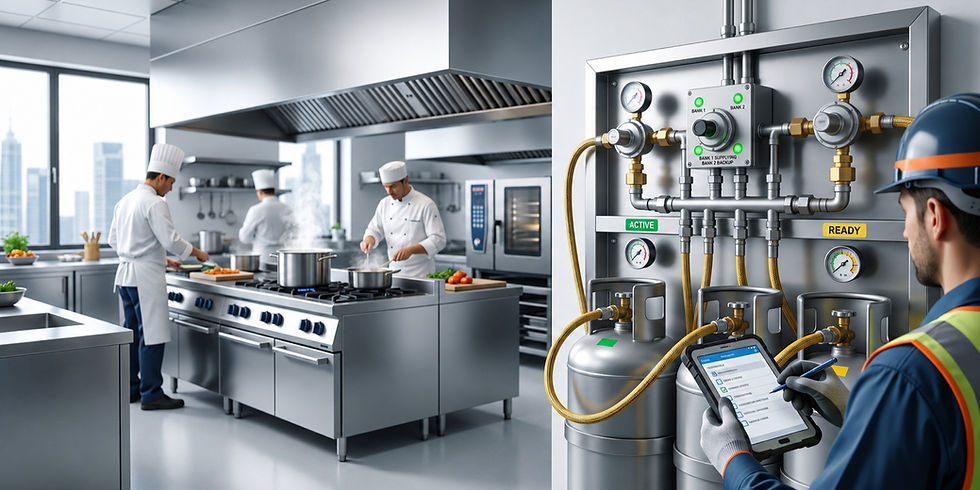
LPG cylinders → Pigtails → Manifold → Regulation → Gas piping → Appliances
The exact configuration depends on the installation design.
For larger systems, the regulator may form part of a multi-stage pressure-control arrangement.
SCDF's Fire Code requires LPG plans to show relevant components such as regulators, changeover valves, emergency shut-off valves, and other LPG system fittings.
4. Regulator Standards and Certification
Price should never be the first consideration when purchasing an LPG regulator.
The regulator should meet the applicable standards for the intended application.
For Singapore LPG installations, SCDF's Annex 10.1A lists the applicable regulator standards as:
SS 281
BS 3016
UL 144
SS 281 is specifically identified by SCDF as the specification for pressure regulators for LPG.
When purchasing a Commercial LPG regulator Singapore businesses should ask the supplier what standard the proposed regulator complies with and whether documentation is available.
5. Overpressure Protection
A good LPG regulation system needs protection against excessive downstream pressure.
SCDF specifies requirements for overpressure protection devices. These devices are designed to protect the downstream system if outlet pressure exceeds the permitted limit.
The Fire Code states that, in general, an overpressure protection device should help:
Provide reliable and continuous LPG supply
Protect downstream equipment against overpressure
Protect against failure of regulating equipment
SCDF also specifies that the setting of the overpressure protection device should not be more than 30% of maximum operating pressure.
This is one reason why commercial LPG systems should be designed and installed by appropriately qualified professionals.
6 .Temperature and Installation Conditions
The operating environment can also affect regulator selection.
Commercial LPG equipment may be exposed to:
Outdoor conditions
Heat
Moisture
Dust
Mechanical impact
Frequent operation
The regulator should be suitable for its intended environment and installed according to the manufacturer's requirements.
A regulator that is technically suitable but installed incorrectly may not provide the expected performance.
7 Future Kitchen Expansion
Think beyond your current kitchen.
If you are opening a restaurant today but expect to add:
More burners
Additional ovens
A second cooking line
Catering operations
Higher production capacity
your future gas demand may be greater than today's requirement.
Discuss potential expansion with your LPG supplier or qualified gas professional before selecting the regulator.
However, oversizing should also be avoided. The goal is to select equipment appropriate for the actual system design rather than simply choosing the largest regulator available.
What LPG Regulator Is Best for Commercial Kitchens?
So, what LPG regulator is best for commercial kitchens?
There isn't one regulator that is best for every restaurant.
The appropriate regulator depends on:
Factor | Why It Matters |
LPG supply pressure | Determines the regulator's inlet requirements |
Required outlet pressure | Must match the downstream system |
Gas flow | Determines whether it can meet peak demand |
Number of appliances | Affects total gas demand |
Cylinder/manifold setup | Influences regulator configuration |
Standards | Ensures suitability and compliance |
Installation environment | Affects equipment selection |
Overpressure protection | Protects downstream equipment |
A qualified installer should determine the appropriate specification based on the complete LPG system.
How to Choose an LPG Pressure Regulator for a Restaurant in Singapore
If you're researching how to choose an LPG pressure regulator for a restaurant in Singapore, follow this process.
Step 1: List Your LPG Appliances
Write down every appliance that uses LPG.
For example:
Wok burners
Ranges
Ovens
Fryers
Grills
Steamers
Step 2: Check Manufacturer Specifications
Look at each appliance's documentation for its required gas type, pressure and input rating.
Don't estimate these values when manufacturer information is available.
Step 3: Calculate Total Demand
Consider the gas input of appliances that could operate simultaneously.
This helps determine the required regulator flow capacity.
Step 4: Identify Your LPG Supply Arrangement
Determine whether the kitchen uses:
Individual cylinders
Multiple cylinders
A manifold system
A changeover system
Step 5: Determine Pressure Stages
Your LPG professional can determine whether the installation requires single-stage or multi-stage regulation based on the system design.
Step 6: Confirm Applicable Standards
Make sure the proposed regulator complies with the applicable Singapore requirements and relevant standards.
Step 7: Have the Installation Checked
For commercial premises, EMA states that consumers are required to engage a Licensed Gas Service Worker (LGSW) or Professional Engineer (PE) to inspect and certify that the gas installation is safe for use.
What Size LPG Regulator Does a Commercial Kitchen Need?
This is one of the most common questions from restaurant owners.
The answer depends on gas demand and pressure requirements, not simply the physical size of the kitchen.
To determine the appropriate regulator, consider:
Total Appliance Load
Add the LPG input requirements of the relevant appliances.
Simultaneous Usage
Consider how many appliances may run at the same time.
Required Outlet Pressure
The regulator must provide the pressure required by the downstream equipment.
Future Demand
Consider planned expansion without unnecessarily oversizing the system.
Pipework
The gas piping must also be capable of supplying the required flow.
SCDF's Fire Code states that when additional gas utilisation equipment is connected to an existing gas piping system, the existing piping must be checked for adequate capacity. If it is inadequate, the system should be enlarged or separate adequate gas equipment provided.
This illustrates an important point: you cannot select a regulator in isolation from the rest of the gas system.
LPG Regulator vs LPG Manifold: What's the Difference?
These two components are sometimes confused.
LPG Manifold
A manifold connects multiple LPG cylinders into a common supply arrangement.
LPG Regulator
A regulator controls gas pressure within the system.
In a commercial installation, they may work together.
For example:
Multiple LPG cylinders → Manifold → Regulator → Gas piping → Kitchen appliances
Depending on the design, there can be multiple pressure-regulation stages and other safety components.
SCDF's requirements specifically cover LPG storage and manifold systems, including regulators and emergency shut-off equipment.
Common LPG Regulator Mistakes to Avoid
Choosing Based Only on Price
A cheaper regulator isn't necessarily the right regulator.
Check its specifications, certification and suitability for the application.
Ignoring Flow Capacity
A regulator may provide the correct pressure but still be unsuitable if it cannot meet the required gas flow.
Using the Wrong Pressure
The outlet pressure must match the downstream system's requirements.
Mixing Incompatible Components
Regulators, hoses, valves and other components should be compatible with the LPG installation.
Ignoring Existing Pipe Capacity
Upgrading a regulator doesn't automatically solve a gas-supply problem if the downstream piping cannot handle the required flow.
Installing It Yourself
Commercial LPG systems should be designed and installed by appropriately qualified professionals.
How Can You Tell If an LPG Regulator May Have a Problem?
A regulator should be inspected if you notice unusual behaviour such as:
Unstable appliance flames
Unexpected pressure fluctuations
Poor burner performance
Frequent appliance shutdown
Unusual gas odour
Visible physical damage
Corrosion
Abnormal noises
These symptoms don't necessarily mean the regulator itself is faulty. The problem could originate elsewhere in the LPG system.
Do not attempt to repair or modify a gas regulator yourself. Shut down the system safely where appropriate and contact a qualified professional.
LPG Regulator Maintenance Tips for Commercial Kitchens
A regulator isn't a "fit and forget" component.
Include it in your regular gas-system inspection programme.
Check for Visible Damage
Look for corrosion, cracks, dents or other physical damage.
Check Connections
Connections should be secure and free from signs of leakage.
Monitor Appliance Performance
Unexpected changes in burner performance may indicate a problem somewhere in the gas system.
Keep Documentation
Record inspections, maintenance and replacement dates.
Replace When Required
Regulators should be replaced according to their condition, manufacturer's requirements and professional recommendations—not simply because a cheaper alternative is available.
EMA recommends periodic inspection of gas installations to identify issues such as leaks, corrosion and damaged pipes.
Safety Requirements for LPG Regulators in Singapore
For a commercial LPG installation, regulator selection is only one part of the safety system.
SCDF's current Fire Code covers commercial LPG cylinder installations and includes requirements concerning regulators, emergency shut-off valves, gas leak detection and other safety provisions.
For example, SCDF specifies gas leak detection systems for areas involving LPG piping systems, with automatic gas shut-off and alarm functions under the applicable requirements.
The Code also specifies that emergency shut-off arrangements are required for relevant LPG installations.
Because requirements can vary according to the installation, always have your system assessed against the current applicable regulations rather than relying on a generic online recommendation.
A Simple LPG Regulator Selection Checklist
Before purchasing a regulator for your commercial kitchen, ask:
What is the LPG inlet pressure?
What outlet pressure does the kitchen require?
What is the maximum gas demand?
How many appliances may operate simultaneously?
Is the system supplied by one cylinder or a manifold?
Does the regulator meet the applicable standard?
Does it have appropriate overpressure protection?
Is it suitable for the installation environment?
Is the existing pipework adequate?
Who will install and certify the system?
If you cannot answer these questions, don't guess. Get the system assessed by a qualified LPG professional.
Frequently Asked Questions
What is an LPG regulator used for?
An LPG regulator controls and reduces gas pressure from the LPG supply to a suitable pressure for the downstream gas system and appliances.
What LPG regulator is best for commercial kitchens?
The best regulator depends on the kitchen's required outlet pressure, total gas demand, LPG cylinder or manifold arrangement, applicable standards and system design. There is no universal regulator for every commercial kitchen.
What size LPG regulator does a commercial kitchen need?
The required regulator capacity depends primarily on the gas demand of the connected appliances and the required operating pressure. A qualified professional should size it based on the complete gas installation.
How do I choose an LPG pressure regulator for a restaurant in Singapore?
Identify your appliances and their pressure requirements, calculate peak gas demand, determine your cylinder or manifold configuration, verify applicable standards, and have the regulator selected and installed as part of the overall system design.
Are LPG regulators required to meet Singapore standards?
Yes. SCDF's Fire Code identifies applicable standards for LPG regulators, including SS 281, BS 3016 and UL 144.
Can I use the same LPG regulator for every appliance?
Not necessarily. Different appliances and gas systems can have different pressure and flow requirements. The regulator should be selected according to the complete installation.
How often should an LPG regulator be replaced?
There is no single replacement interval that applies to every installation. Condition, manufacturer recommendations, operating environment and inspection findings should be considered.
Can a regulator fix low gas pressure in my commercial kitchen?
Not necessarily. Low pressure can result from an incorrectly sized regulator, insufficient LPG supply, inadequate piping, excessive simultaneous demand, or another system problem. The entire installation should be assessed before changing the regulator.
Conclusion
Choosing the right LPG regulator for commercial kitchens isn't about finding the biggest or cheapest option. It's about matching the regulator to your LPG supply, required pressure, peak gas demand, appliances, piping and safety requirements.
For restaurants in Singapore, regulator selection should also take applicable standards and regulatory requirements into account. SCDF identifies standards for LPG regulators and sets requirements for commercial LPG installations, while EMA requires appropriate professional inspection and certification for commercial gas installations.
Before purchasing a Commercial LPG regulator Singapore businesses should therefore consider the complete system not just the regulator itself.
If you're setting up a new commercial kitchen, upgrading your LPG system, or unsure which regulator is appropriate for your restaurant, getting professional advice can prevent costly mistakes.
Contact Jia Liang LPG today to discuss your commercial kitchen LPG requirements and find the right solution for your business.


Comments