-2.png)
LPG Setup Checklist for New Restaurants in Singapore

Opening a restaurant in Singapore involves more than choosing the right menu, kitchen equipment, and location. If your commercial kitchen relies on LPG, getting the LPG setup for restaurants in Singapore right from the beginning can help you avoid costly delays, supply interruptions, and safety issues.
From selecting the right cylinders and planning the manifold system to arranging compliant installation and regular inspections, every part of the LPG setup needs careful planning. This checklist walks you through the key things new restaurant owners should consider before opening their kitchen.
LPG installation requirements depend on the premises, system design, cylinder capacity, and applicable Singapore regulations. Always have the proposed installation assessed by the appropriate qualified professionals before use.
What Does a New Restaurant Need for LPG Setup?
A typical commercial LPG setup may involve:
LPG cylinders suitable for the kitchen's consumption
Cylinder storage or approved cabinet arrangement
LPG manifold system, where applicable
Regulators and valves
Changeover system, where applicable
Gas piping
Appliance connections
Emergency shut-off arrangements
Appropriate fire-safety equipment
Ventilation and safe cylinder positioning
Inspection, testing, and certification by the appropriate professionals
SCDF's Fire Code specifically covers LPG cylinder installations used by restaurants, eating outlets, canteens, and other eateries. For commercial and industrial buildings, LPG cylinders are generally required to be installed outdoors and at ground level unless an approved arrangement permits otherwise.
LPG Setup Checklist for New Restaurants in Singapore
Before your restaurant opens, work through the following checklist.
LPG Planning Checklist
Estimate expected LPG consumption
Identify all LPG-powered appliances
Select appropriate cylinder capacity and quantity
Determine whether a manifold system is required
Plan the cylinder storage location
Check applicable SCDF requirements
Plan gas piping routes
Select suitable regulators and valves
Plan emergency shut-off arrangements
Engage appropriately licensed professionals
Test and inspect the installation
Establish an LPG delivery schedule
Train relevant kitchen staff
Schedule regular inspections and maintenance
Let's look at each stage in more detail.
1. Calculate Your Restaurant's LPG Requirements
Before buying equipment, estimate how much LPG your kitchen is likely to consume.
Your LPG requirement depends on:
Number of burners
Type of cooking
Operating hours
Number of meals prepared
Kitchen size
LPG-powered ovens and fryers
Peak cooking periods
Future expansion plans
For example, a small café with two burners may have very different requirements from a restaurant operating several wok ranges, fryers, and ovens.
A Simple Starting Formula
Estimated monthly LPG consumption = Average daily consumption × Operating days
If you already operate another outlet, use its LPG consumption as a reference. If you're opening your first restaurant, discuss your planned appliances and operating schedule with an experienced LPG supplier.
Avoid choosing cylinder capacity based purely on guesswork. Accurate consumption estimates can help you avoid frequent replacements or unnecessarily large installations.
2. List Every LPG-Powered Appliance
The next step in your commercial kitchen LPG setup Singapore planning is to identify every appliance that will use LPG.
Create a list such as:
Commercial gas burners
Wok stoves
Cooking ranges
Gas ovens
Fryers
Grills
Steamers
Stock-pot burners
For each appliance, record its manufacturer, model, LPG input rating, and expected operating hours where available.
This information helps your LPG professional understand the expected gas demand and design the supply system accordingly.
3. Choose the Right LPG Cylinder Size
Cylinder selection should be based on actual consumption, available space, delivery requirements, and the approved installation design.
A larger cylinder isn't automatically better.
For a restaurant with high LPG demand, larger-capacity cylinders connected through a suitable manifold system may simplify supply management. A smaller restaurant may have different requirements.
When comparing LPG cylinder sizes Singapore, consider:
LPG consumption
Cylinder capacity
Number of cylinders
Delivery frequency
Storage space
Manifold configuration
Applicable fire-safety requirements
The objective is to create a system that provides adequate LPG without unnecessarily complicating the installation.
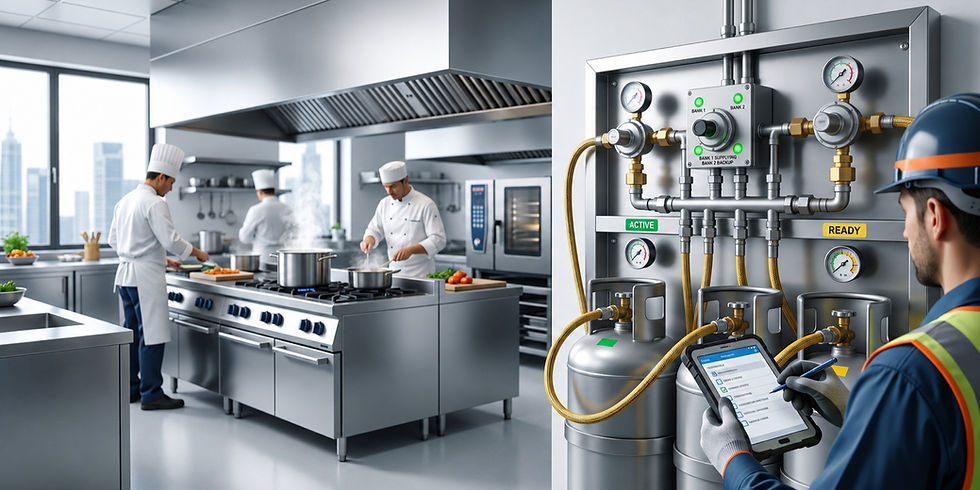
4. Decide Whether You Need an LPG Manifold System
A manifold connects multiple LPG cylinders to a common supply system.
For restaurants with significant and consistent LPG demand, a manifold can provide a more structured way of supplying gas to multiple appliances.
A commercial manifold system may include:
Cylinder connections
Manifold header
Regulators
Changeover valves
Pressure gauges
Isolation valves
Emergency shut-off equipment
Gas piping
SCDF's Fire Code includes specific provisions for manifold installations. For eating outlets, installations of up to 600kg attached to a single manifold system may be permitted when the stated conditions are met. The Code specifies, among other requirements, limits on cabinet and cylinder quantities.
Your supplier or qualified professional should determine whether a manifold is appropriate for your premises.
5. Plan the LPG Cylinder Storage Location
Cylinder placement is one of the most important parts of your restaurant LPG installation Singapore planning.
Don't wait until the kitchen renovation is complete before deciding where the cylinders will go.
SCDF states that LPG cylinders for commercial and industrial buildings should generally be located outdoors and at ground level, with specific requirements for ventilation, access, separation distances, and protection.
For example, the Fire Code specifies minimum separation distances from certain exits, building openings, mechanical air intakes, vehicle parking areas, boundaries, fire engine accessways, and fire hydrants.
This means your LPG location needs to be considered during the restaurant's layout and renovation planning.
6. Check Your LPG Storage and Cabinet Requirements
Depending on the installation, cylinders may need suitable protection against public access, accidental damage, or tampering.
SCDF's requirements include provisions for protecting LPG cylinder installations that are accessible to the public, including suitable fencing, housing, or non-combustible cabinets.
Your LPG professional should determine the appropriate arrangement based on:
Cylinder quantity
Location
Building layout
Installation type
Applicable SCDF requirements
Never use an ordinary storage cabinet as an LPG cabinet unless it is specifically suitable and compliant for the intended application.
7. Plan the Gas Piping Route
Once the cylinder location is determined, plan how gas will travel from the LPG installation to the kitchen.
An effective piping plan should consider:
Distance between cylinders and kitchen
Number of appliances
Pipe routing
Isolation points
Access for maintenance
Protection from physical damage
Building penetrations
Avoid making major layout decisions before the gas piping route has been assessed.
Where piping passes through fire-rated walls or floor slabs, SCDF requires appropriate fire stopping.
8. Select Regulators, Valves and Safety Equipment
The LPG system isn't simply cylinders connected to pipes.
A properly designed system may require components such as:
Pressure regulators
Changeover valves
Isolation valves
Emergency shut-off valves
Pressure gauges
Gas detection equipment where required
Appropriate appliance connections
The exact configuration depends on the system design.
SCDF's Fire Code requires LPG installations to have specified safety provisions, including at least one approved portable B:C dry chemical fire extinguisher with a minimum capacity of 9kg and appropriate warning signs/notices.
9. Make Sure the Installation Is Professionally Completed
One of the most important LPG system requirements for restaurants in Singapore is ensuring that gas installation work is carried out by the appropriate licensed professionals.
EMA states that gas service work involving piped gas installations or piped gas appliances must be undertaken by a Licensed Gas Service Worker. Such work includes new installations and alterations to existing installations, and the work must be tested before the piped gas supply can be turned on.
For gas installations operating above 30 mbars, relevant work must be carried out by or under the supervision of a Professional Engineer with a Mechanical Engineering discipline.
For commercial premises, EMA also states that consumers are required to engage a Licensed Gas Service Worker or Professional Engineer to inspect and certify that the gas installation is safe for use.
Before hiring an installer, ask:
Is the worker appropriately licensed?
What work is included?
Will the system be tested after installation?
Who will handle inspection and certification?
Does the proposed installation comply with applicable requirements?
You can also verify licensed gas service workers through EMA's E-Licence Information Services (ELISE).
10. Check the Installation Before Opening
Don't wait until the first day of business to discover an LPG problem.
Before opening the kitchen, check that:
LPG cylinders are correctly positioned
Valves and regulators are installed correctly
Gas piping has been tested
Appliances are connected appropriately
Emergency shut-off arrangements work
Required safety equipment is available
Warning signs are in place
Staff understand basic LPG safety procedures
Required inspection and certification have been completed
A proper pre-opening check gives you time to correct issues before customers arrive.
11. Plan Your LPG Delivery Schedule
A restaurant running out of LPG during dinner service can bring kitchen operations to a halt.
Your delivery schedule should be based on actual consumption.
Track:
Average daily LPG usage
Peak consumption
Cylinder replacement frequency
Delivery lead time
Emergency requirements
Expected seasonal demand
For a new restaurant, your first few months of consumption data will be particularly valuable.
Once you know your average usage, you can work with your LPG supplier to establish a more reliable delivery schedule.
12. Train Your Kitchen Staff
Equipment is only one part of LPG safety. Staff behaviour matters too.
Train relevant employees on:
How to operate LPG appliances
How to shut off gas supply
Where emergency shut-off controls are located
What to do if they suspect a leak
Keeping combustible materials away from gas equipment
Reporting damaged hoses or fittings
Basic emergency procedures
Make sure new employees receive the same safety briefing when they join.
13. Establish a Maintenance and Inspection Routine
Your LPG setup shouldn't be treated as a one-time installation.
Regular inspections can identify problems such as:
Gas leaks
Corrosion
Damaged pipes
Faulty connections
Worn components
Appliance issues
EMA notes that periodic inspection of gas installations is important for detecting issues such as leaks, corrosion, or damaged pipes early.
Create a simple maintenance record showing:
Item | Check |
LPG cylinders | Condition and connections |
Regulators | Condition and performance |
Hoses | Damage or deterioration |
Valves | Operation |
Piping | Leaks or corrosion |
Appliances | Performance |
Safety equipment | Availability |
Inspection records | Updated |
What LPG Equipment Does a New Restaurant Need in Singapore?
If you're wondering what LPG equipment a new restaurant needs in Singapore, the answer depends on your kitchen design and approved LPG system.
A commercial setup may include:
LPG Supply Equipment
LPG cylinders
Manifold system, where applicable
Cylinder cabinet or approved housing, where required
Regulators
Changeover system
Gas Distribution Equipment
Gas piping
Valves
Appliance connections
Pressure-control components
Safety Equipment
Emergency shut-off arrangements
Fire extinguisher
Warning signage
Gas detection equipment where required
Suitable ventilation
Not every restaurant needs every component. Your installation should be designed around your actual LPG requirements and applicable regulations.
Common LPG Setup Mistakes New Restaurants Should Avoid
Choosing Equipment Before Planning the Layout
Buying LPG cylinders and appliances before confirming the installation location can create expensive redesigns.
Selecting Cylinders Based Only on Price
The cheapest option may not be the most practical for your consumption or installation.
Ignoring Future Expansion
If you plan to add appliances later, mention this during the initial design stage.
Treating LPG Storage as an Afterthought
Cylinder placement can affect restaurant layout, fire safety, and installation feasibility.
Hiring Based Only on the Lowest Quote
Gas installation is not an area where cutting corners is worth the risk.
Always verify the relevant professional's credentials and understand exactly what is included in the quotation.
Practical LPG Setup Example for a New Restaurant
Imagine a new restaurant opening with:
Six commercial gas burners
One fryer
One gas oven
12-hour operating days
High lunch and dinner demand
The owner should first estimate expected LPG consumption and identify the appliances' gas requirements.
Next, the LPG supplier or qualified professional can assess:
Appropriate cylinder capacity
Number of cylinders
Whether a manifold system is suitable
Cylinder storage location
Gas piping route
Regulators and valves
Safety equipment
Inspection and certification requirements
This approach is much better than installing equipment first and trying to solve the LPG system afterwards.
Frequently Asked Questions
How do I set up LPG for a restaurant in Singapore?
Start by estimating LPG consumption, listing your gas-powered appliances, planning an appropriate cylinder and manifold arrangement, selecting a compliant storage location, designing the gas piping, and engaging the appropriate licensed professionals for installation, testing, and certification.
What LPG equipment does a new restaurant need in Singapore?
Depending on the installation, a restaurant may need LPG cylinders, regulators, valves, gas piping, appliance connections, a manifold or changeover system, emergency shut-off equipment, fire-safety equipment, and other required components.
What are the LPG safety requirements for restaurants in Singapore?
Requirements depend on the installation, but SCDF's Fire Code covers cylinder location, separation distances, ventilation, cylinder quantities, protection, safety equipment, and manifold arrangements for commercial LPG installations.
Do restaurants need a licensed professional for LPG installation?
Gas service work involving piped gas installation or piped gas appliances must be carried out by the appropriately licensed gas service professional under EMA's requirements. Commercial installations also require appropriate inspection and certification.
Where should LPG cylinders be stored at a restaurant?
For commercial and industrial buildings, SCDF generally requires LPG cylinders to be installed outdoors and at ground level, subject to specific provisions and approved exceptions. The installation must also meet applicable ventilation and separation requirements.
How many LPG cylinders does a restaurant need?
There is no universal number. The requirement depends on LPG consumption, appliance demand, cylinder capacity, delivery arrangements, and the approved installation design.
How often should a restaurant's LPG system be inspected?
Inspection requirements depend on the applicable gas installation regime. EMA states that periodic inspection is necessary to identify issues such as leaks, corrosion, and damaged pipes, and current requirements include provisions concerning Certificates of Fitness.
Conclusion
Setting up LPG for a new restaurant is much easier when you plan the system before the kitchen is built. From estimating LPG setup for restaurants in Singapore requirements to choosing cylinders, planning a manifold, positioning the installation, and arranging professional inspection, each decision can affect safety, cost, and day-to-day kitchen operations.
Don't treat LPG as an afterthought during your restaurant renovation. Plan the supply system alongside your kitchen layout so your equipment, storage, piping, and safety requirements work together from day one.
If you're opening a new restaurant and need help planning your LPG requirements, Jia Liang LPG can help you understand your commercial LPG needs and supply options.
Contact Us today to discuss your restaurant LPG setup and get started.


Comments