-2.png)
LPG vs Natural Gas for Commercial Kitchens: Which Fuel Is Right for Your Business?

Choosing the right fuel source can significantly impact the efficiency, operating costs, and reliability of a commercial kitchen. Whether you operate a restaurant, hotel kitchen, café, catering business, or food court stall, your fuel choice affects everything from cooking performance to long-term profitability.
When comparing LPG vs Natural Gas for Commercial Kitchens, there is no universal answer. Each fuel option offers unique advantages and limitations. In this guide, we'll break down the key differences, compare costs, evaluate performance, and help you determine which fuel best suits your business needs.
Understanding LPG and Natural Gas
Before conducting a proper Commercial Kitchen Gas Comparison, it's important to understand how these fuels differ.
What Is LPG?
Liquefied Petroleum Gas (LPG) is a fuel primarily composed of propane and butane.
It is:
Stored in cylinders or bulk tanks
Delivered directly to the customer
Suitable for locations without gas pipeline access
Highly energy-dense
Many restaurants rely on LPG for Commercial Kitchens because of its flexibility and portability.
What Is Natural Gas?
Natural gas primarily consists of methane and is delivered through underground gas pipelines.
It is:
Continuously supplied through utility networks
Common in urban areas
Often used by large commercial facilities
Dependent on local gas infrastructure
Many businesses choose Natural Gas for Commercial Kitchens where pipeline access is readily available.
LPG vs Natural Gas for Commercial Kitchens: Quick Comparison
Factor | LPG | Natural Gas |
Energy Content | Higher | Lower |
Supply Method | Cylinders or tanks | Pipeline |
Installation Flexibility | Excellent | Limited to pipeline availability |
Portability | High | Low |
Initial Infrastructure Cost | Moderate | Can be higher depending on location |
Fuel Availability | Flexible | Dependent on utility network |
Heat Output | Higher |
This overview highlights some of the key differences between the two commercial kitchen fuel options.
Why Fuel Choice Matters in Commercial Kitchens
Commercial kitchens require:
Consistent heat output
Reliable fuel supply
Cost-effective operation
Minimal downtime
Safe working conditions
A poor fuel choice can increase operating costs, disrupt kitchen operations, and impact customer service.
That's why understanding LPG vs Natural Gas is essential before making a long-term decision.
Benefits of LPG for Commercial Kitchens
Many food service businesses choose LPG because of its operational flexibility and performance advantages.
1. Higher Energy Efficiency
LPG contains more energy per unit than natural gas.
This means:
Faster heating
Improved cooking performance
Better temperature control
For chefs, precise heat control is often critical during food preparation.
2. Reliable Supply Options
Unlike pipeline-dependent systems, LPG can be stored onsite.
Benefits include:
Reduced dependence on utility infrastructure
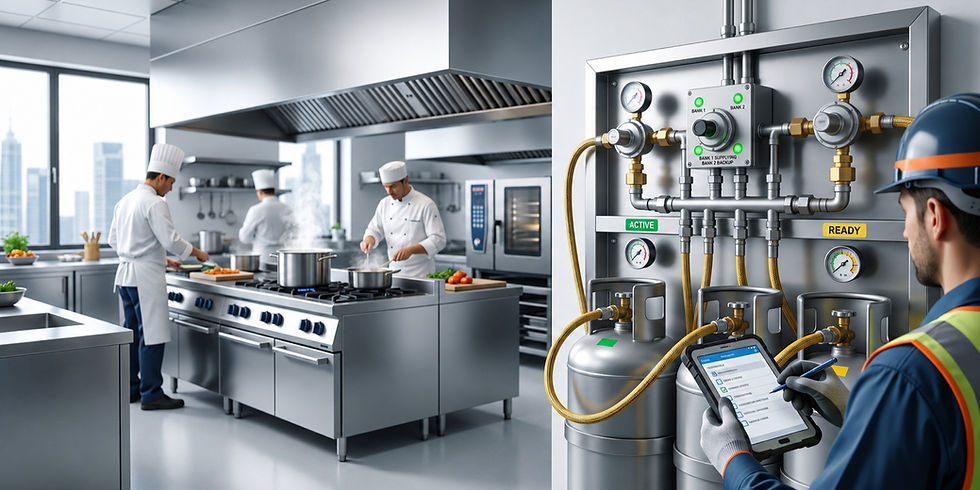
Backup fuel availability
Greater operational resilience
Restaurants can continue operating even if external utility disruptions occur.
3. Suitable for Remote Locations
Businesses located outside pipeline service areas often rely on LPG.
Examples include:
Resorts
Outdoor dining facilities
Temporary kitchens
Remote commercial sites
This flexibility makes LPG one of the most adaptable Commercial Kitchen Fuel Options available.
4. Easy Scalability
As business demand grows, LPG systems can be expanded through:
Additional cylinders
LPG manifold systems
Bulk storage solutions
This flexibility supports future business growth.
Advantages and Disadvantages of Natural Gas for Restaurants
Natural gas also offers several benefits depending on the location and operational requirements.
Advantages
Continuous Supply
Natural gas pipelines provide uninterrupted fuel delivery without cylinder replacements.
Reduced Storage Requirements
No onsite fuel storage is typically required.
Convenience
Businesses do not need to schedule cylinder deliveries.
Disadvantages
Infrastructure Dependency
Natural gas service is only available where pipeline networks exist.
Potential Utility Disruptions
Pipeline maintenance or utility outages may affect supply.
Installation Constraints
Expanding service may require infrastructure modifications.
Understanding these Advantages and Disadvantages of Natural Gas for Restaurants is important when evaluating long-term fuel strategies.
LPG vs Natural Gas Cost Comparison for Restaurants
One of the most frequently asked questions is:
LPG vs Natural Gas Cost Comparison for Restaurants
The answer depends on several factors:
Local fuel prices
Consumption volume
Infrastructure costs
Delivery arrangements
Equipment efficiency
Initial Setup Costs
LPG systems may require:
Cylinders
Manifold systems
Regulators
Natural gas systems may require:
Pipeline connections
Utility approvals
Infrastructure upgrades
Operating Costs
Fuel prices fluctuate over time and vary by region.
While natural gas may sometimes offer lower fuel costs, LPG often provides:
Higher energy content
Faster heating performance
Operational flexibility
The most cost-effective solution depends on the specific needs of the business.
Commercial Kitchen Gas Comparison: Performance Factors
When evaluating fuel options, performance often matters more than fuel price alone.
Heat Output
LPG generally delivers:
Stronger flame intensity
Faster heating
Better responsiveness
Temperature Control
Chefs often value precise temperature adjustments for:
Stir-frying
Grilling
High-heat cooking
Cooking Speed
Faster heating can improve kitchen productivity during peak service periods.
These factors contribute significantly to operational efficiency.
Which Is Better for Commercial Kitchens: LPG or Natural Gas?
The answer depends on your business priorities.
LPG May Be Better If:
You need flexibility.
Pipeline access is unavailable.
High heat output is important.
You require backup fuel options.
You operate in remote locations.
Natural Gas May Be Better If:
Pipeline access already exists.
Continuous utility supply is available.
Storage space is limited.
Utility-based service is preferred.
There is no one-size-fits-all solution. The best choice depends on operational requirements and local infrastructure.
Use Cases: Choosing the Right Fuel
Small Restaurants and Cafés
LPG often provides flexibility and easy installation.
Large Urban Restaurants
Natural gas may be attractive if pipeline access is readily available.
Catering Businesses
LPG offers portability and mobility advantages.
Hotels and Commercial Kitchens
Both options can be effective depending on infrastructure and demand levels.
Key Questions to Ask Before Choosing
Before selecting a fuel source, consider:
Is natural gas available at your location?
What are your expected fuel consumption levels?
Do you need backup fuel options?
How important is installation flexibility?
What are your future expansion plans?
Answering these questions can simplify the decision-making process.
Frequently Asked Questions (FAQs)
1. What is the difference between LPG and natural gas?
LPG is stored in cylinders or tanks, while natural gas is supplied through pipelines. LPG also has a higher energy content per unit.
2. Which is better for commercial kitchens: LPG or natural gas?
The best option depends on location, infrastructure, fuel availability, cooking requirements, and business goals.
3. What are the benefits of LPG for commercial kitchens?
Benefits include higher heat output, installation flexibility, portability, backup fuel availability, and suitability for remote locations.
4. What are the advantages and disadvantages of natural gas for restaurants?
Advantages include continuous supply and reduced storage needs, while disadvantages include infrastructure dependency and limited availability in some areas.
5. How does LPG vs natural gas cost comparison for restaurants work?
The comparison involves fuel costs, infrastructure expenses, operating efficiency, and long-term business requirements.
6. Is LPG safer than natural gas?
Both fuels can be used safely when installed, maintained, and operated according to industry standards.
7. What is the best commercial kitchen fuel option?
The best fuel option depends on operational needs, location, infrastructure availability, and long-term business objectives.
Conclusion
The debate surrounding LPG vs Natural Gas for Commercial Kitchens ultimately comes down to your business's specific requirements. LPG offers exceptional flexibility, portability, and high-performance cooking capabilities, while natural gas provides continuous pipeline-based supply where infrastructure is available.
When evaluating Commercial Kitchen Fuel Options, consider factors such as location, fuel availability, operational costs, cooking performance, and future growth plans. A thorough Commercial Kitchen Gas Comparison will help ensure you choose the most efficient and reliable fuel solution for your restaurant or commercial kitchen.
Need help choosing between LPG and natural gas for your commercial kitchen? Our experts can assess your operational needs and recommend the most suitable fuel solution. Contact us today, book a consultation, visit our website, or get started with a customized commercial kitchen gas system.


Comments