-2.png)
Why Is My LPG Flame Yellow Instead of Blue?

A yellow LPG flame is more than a change in colour; it can be a sign that your burner is not getting the correct air-to-gas mixture. For a home kitchen it may indicate a burner or ventilation issue; in a busy commercial kitchen, it deserves prompt attention.
A properly adjusted LPG burner generally produces a steady blue flame. If the flame becomes yellow, orange, weak, or unusually large, don't simply ignore it. The cause could range from a dirty burner to an incorrect gas pressure or an appliance-related problem.
If your LPG flame is yellow instead of blue, switch off the appliance and allow it to cool. Common causes include blocked burner ports, dirt or grease, insufficient air, incorrect gas pressure, poor burner adjustment, or a problem with the appliance. If cleaning the accessible burner components does not resolve the issue, have the appliance and gas installation checked by a qualified professional.
What Does a Blue LPG Flame Mean?
A blue flame generally indicates that LPG is burning with an appropriate air-to-fuel mixture and relatively complete combustion.
When combustion is working properly, you typically see:
A predominantly blue flame
A steady flame pattern
Consistent burner performance
Little or no soot formation
A yellow flame on an LPG burner, by comparison, can indicate incomplete combustion or another problem affecting the burner.
The flame colour itself isn't enough to diagnose the exact fault, but it is an important warning sign.
Why Is My LPG Flame Yellow Instead of Blue?
There are several possible reasons.
The most common include:
Dirty or blocked burner ports
Grease or food debris around the burner
Insufficient air supply
Incorrect gas pressure
Incorrect burner adjustment
Damaged burner components
Poor ventilation
An LPG regulator or supply problem
Let's look at each one.
1. Dirty or Blocked Burner Ports
One of the simplest explanations for LPG flame yellow instead of blue is a dirty burner.
Commercial kitchens deal with grease, oil, food particles and cooking residue every day. Over time, these materials can accumulate around burner ports and interfere with the normal gas-and-air mixture.
You may notice:
Yellow or orange flames
Uneven flame distribution
Smaller flames in some areas
Soot around cookware
Reduced heating performance
What to do
Switch off the appliance and allow it to cool completely.
Follow the manufacturer's instructions for removing and cleaning the accessible burner components.
Don't enlarge burner holes, insert unsuitable objects into gas passages, or modify the burner yourself.
If the flame remains yellow after proper cleaning, the problem may be elsewhere in the gas system.
2. Grease and Food Residue
A restaurant burner can become dirty much faster than a household burner.
During busy cooking periods, oil and food particles can reach the burner area. The residue can affect flame distribution and combustion.
This is why regular commercial kitchen cleaning isn't only about appearance.
It can also help maintain proper appliance performance.
Good practice
Include LPG burners in your regular kitchen maintenance routine:
Clean spills promptly
Remove accumulated grease
Keep burner openings clear
Follow the manufacturer's cleaning instructions
Inspect burners for damage
3. Insufficient Air Supply
LPG needs the correct amount of oxygen to burn properly.
If the burner isn't receiving enough air, combustion can be affected and the flame may become yellow.
Possible reasons include:
Blocked air openings
Poor burner adjustment
Appliance installation issues
Inadequate ventilation
Obstructions around the appliance
This is particularly important in commercial kitchens where several gas appliances may operate simultaneously.
Don't assume that increasing LPG pressure will solve an air-supply problem.
The gas and air mixture needs to be correctly balanced.
4. Incorrect LPG Gas Pressure
Gas pressure can also affect burner performance.
If the pressure supplied to an appliance isn't within the manufacturer's specified range, the burner may not operate correctly.
A problem with the:
LPG regulator
Changeover system
Manifold
Gas piping
Appliance connection
could potentially contribute to abnormal flame behaviour.
This is why a LPG burner flame problem shouldn't automatically be blamed on the burner itself.
A professional may need to inspect the complete LPG supply system.
5. Incorrect Burner Adjustment
Commercial cooking appliances are designed to operate with specific gas and air settings.
If a burner has been incorrectly adjusted, the flame may become unstable or change colour.
This can happen after:
Appliance servicing
Burner replacement
Gas system modifications
Incorrect installation
Unauthorised adjustments
Don't attempt to change gas pressure or burner settings simply to make the flame look blue.
The appliance should be adjusted according to its manufacturer's specifications by a suitably qualified professional.
6. Damaged Burner Components
Burners can deteriorate through regular use.
Look for signs such as:
Cracks
Deformation
Corrosion
Damaged burner ports
Loose components
Uneven flame patterns
A damaged burner may not mix LPG and air correctly.
If a component is damaged, replacing it with the correct manufacturer-approved part is generally safer than trying to repair or modify it.
7. Poor Kitchen Ventilation
Ventilation is especially important in a commercial kitchen.
Your kitchen needs adequate ventilation to manage combustion products, heat, smoke, grease and air supply.
A problem with the ventilation system can affect the overall cooking environment.
For example, if exhaust systems aren't functioning correctly, the kitchen may experience poor air movement and increased combustion-product accumulation.
SCDF's Fire Code contains specific requirements for LPG systems and kitchen ventilation. It also states that certain non-fire-rated kitchen exhaust ducts must be separated from unprotected LPG cylinders by specified distances.
So, if your restaurant has suddenly developed unusual burner flames, don't overlook the kitchen's ventilation and exhaust system.
Is a Yellow LPG Flame Dangerous?
A yellow flame shouldn't automatically be treated as proof of a dangerous gas leak, but it should not be ignored.
A persistent yellow flame can indicate incomplete combustion.
Incomplete combustion can produce undesirable combustion products, including carbon monoxide.
The risk becomes particularly important in enclosed or poorly ventilated areas.
Watch for additional warning signs
Pay attention if the yellow flame occurs together with:
Soot around the burner
Unusual gas odour
Headaches or dizziness among occupants
Flame instability
Popping sounds
Appliance malfunction
Unusual heat around the appliance
If you suspect a gas leak, do not use a naked flame to locate it.
EMA advises that if a gas leak is suspected, users should shut off the gas supply, open windows and doors for ventilation, extinguish flames, avoid switching electrical appliances on or off, and move to a safe distance before seeking assistance.
How to Fix a Yellow LPG Flame Safely
If you're asking how to fix a yellow LPG flame safely, start with the simplest possibilities—but don't attempt gas-system repairs yourself.
Step 1: Turn Off the Appliance
Switch off the burner and allow it to cool.
Step 2: Inspect the Burner
Check for visible food residue, grease or blockage.
Step 3: Clean According to Manufacturer Instructions
Clean removable burner components as recommended by the appliance manufacturer.
Step 4: Check Ventilation
Make sure required ventilation and exhaust systems are operating normally.
Step 5: Relight and Observe
Once the appliance is clean and safely reassembled, observe the flame.
A healthy flame should be stable and consistent with the appliance manufacturer's specifications.
Step 6: Stop Using It If the Problem Continues
If the flame remains yellow, becomes unstable, or is accompanied by other warning signs, stop using the appliance and arrange professional inspection.
Don't do this
Avoid:
Increasing LPG pressure yourself
Adjusting regulators without professional guidance
Drilling burner holes
Removing safety devices
Using incompatible replacement parts
Ignoring persistent yellow flames
Yellow Flame vs Blue Flame: What's the Difference?
Feature | Blue LPG Flame | Yellow LPG Flame |
Appearance | Mainly blue | Yellow/orange |
Combustion | Generally indicates appropriate combustion | May indicate incomplete combustion |
Burner condition | Usually operating normally | May require inspection |
Soot | Generally minimal | May occur |
Action | Continue normal maintenance | Investigate if persistent |
Important: Flame colour alone cannot determine whether an appliance is safe. A qualified professional should diagnose persistent or unusual flame behaviour.
Why Yellow Flames Matter More in Commercial Kitchens
A restaurant kitchen can have several LPG appliances operating simultaneously.
Imagine a kitchen using:
6 wok burners
2 fryers
2 ovens
1 grill
If one or more burners suddenly develop yellow flames, the problem shouldn't simply be dismissed as a cosmetic issue.
A commercial kitchen needs reliable:
Gas pressure
Air supply
Ventilation
Burner performance
LPG piping
Regulators
Safety controls
A problem in one part of the system can sometimes affect appliance performance elsewhere.
This is why restaurant operators should treat recurring LPG burner flame problems as a maintenance issue requiring proper diagnosis.
Can an LPG Regulator Cause a Yellow Flame?
Potentially, yes.
The regulator controls gas pressure supplied to the downstream system. If the pressure is incorrect or the regulator isn't suitable for the installation, appliance performance can be affected.
However, a yellow flame doesn't automatically mean the regulator is faulty.
Other possibilities include:
Dirty burner
Incorrect appliance adjustment
Blocked air inlet
Damaged burner
Gas piping issues
Incorrect appliance installation
Ventilation problems
A qualified gas professional can determine whether the issue originates from the appliance or the LPG supply system.
Can Low LPG Supply Cause a Yellow Flame?
Low LPG supply can affect appliance performance, but a yellow flame should not automatically be attributed to an empty cylinder.
If several appliances experience changes at the same time, the LPG supply system may deserve inspection.
Potential areas to check include:
Cylinder supply
Manifold
Automatic changeover system
Regulator
Gas piping
Appliance connections
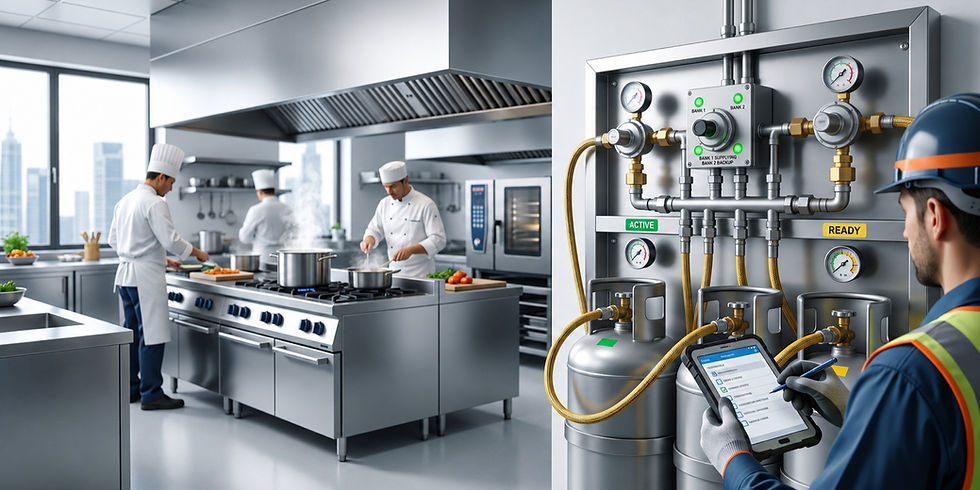
For restaurants using multiple cylinders, an automatic changeover system can help maintain supply continuity, but it doesn't eliminate the need for proper system maintenance.
Yellow Flame and LPG Safety in Singapore
For restaurants and commercial kitchens, LPG flame safety Singapore requirements should be considered as part of the wider gas installation, not just the burner.
SCDF's current Fire Code contains requirements for commercial LPG installations, including gas leak detection systems and automatic gas shut-off arrangements in applicable areas.
SCDF also states that where a fixed fire suppression system is installed for an applicable LPG kitchen installation, activation of the system is to automatically shut off the LPG supply to the kitchen.
For commercial premises, EMA requires consumers to engage a Licensed Gas Service Worker (LGSW) or Professional Engineer (PE) to inspect and certify that the gas installation is safe for use.
This is particularly important when you're experiencing recurring flame abnormalities.
What Should Restaurant Owners Do If Several Burners Turn Yellow?
If multiple burners suddenly change from blue to yellow, don't assume that every burner becomes dirty at the same time.
Consider whether there has been a recent change in:
LPG cylinder supply
Regulator
Manifold
Gas pressure
Gas piping
Appliance settings
Kitchen ventilation
Exhaust operation
A practical approach
Stop using affected appliances if the flame is clearly abnormal.
Check for obvious burner contamination once the equipment is cool.
Check whether ventilation and exhaust systems are operating.
Do not adjust gas pressure yourself.
Contact a qualified gas professional if the problem persists or affects multiple appliances.
How to Prevent LPG Flame Problems
Prevention is much easier than dealing with a kitchen problem during peak service.
Clean Burners Regularly
Grease and food debris should not be allowed to accumulate.
Maintain LPG Equipment
Include regulators, manifolds, valves, hoses and piping in your maintenance programme.
Monitor Flame Behaviour
Kitchen staff should know what normal burner operation looks like.
Maintain Ventilation
Keep kitchen exhaust and ventilation systems properly maintained.
SCDF requires kitchen exhaust systems to be properly maintained and states that the entire exhaust duct and kitchen hood should be degreased and cleaned at least once every 12 months, with records retained by the owner/operator.
Arrange Periodic Professional Inspection
EMA recommends enhanced gas safety through periodic checking of gas pipes and kitchen appliances by a Licensed Gas Service Worker.
A Simple Commercial Kitchen Example
Consider a restaurant where the main wok burners normally produce a stable blue flame.
Over several weeks, the kitchen staff notice that:
Flames are becoming yellow
Black marks appear underneath pans
Cooking takes longer
One burner has an uneven flame
Instead of simply increasing the gas pressure, the restaurant should investigate systematically.
The technician may inspect:
Burner → Air supply → Appliance → Regulator → LPG supply → Gas piping → Ventilation
This approach helps identify the actual cause rather than treating only the visible symptom.
Frequently Asked Questions
Why is my LPG flame yellow instead of blue?
A yellow LPG flame can be caused by a dirty burner, blocked burner ports, insufficient air, incorrect gas pressure, incorrect burner adjustment, damaged components or ventilation problems. Persistent yellow flames should be professionally inspected.
What causes a yellow flame on an LPG burner?
Common causes include grease or food residue, blocked burner openings, poor air-to-gas mixing, incorrect pressure and burner adjustment problems.
Is a yellow LPG flame dangerous for a commercial kitchen?
It can indicate incomplete combustion and should not be ignored. If the flame remains yellow or is accompanied by soot, unusual odours or other symptoms, stop using the appliance and have it checked.
How can I fix a yellow LPG flame safely?
Turn off the appliance, allow it to cool, and clean accessible burner components according to the manufacturer's instructions. If the flame remains yellow, contact a qualified professional rather than adjusting the gas pressure yourself.
Should an LPG flame always be blue?
A properly operating LPG burner will generally produce a predominantly blue flame, but flame appearance can vary by appliance design. The manufacturer's specifications should be used as the reference for normal operation.
Can a dirty burner cause a yellow flame?
Yes. Grease, food particles and other deposits can interfere with normal gas and air mixing and cause abnormal flame behaviour.
Can an LPG regulator cause a yellow flame?
An incorrect gas pressure or regulator problem can contribute to abnormal burner operation, but it is only one possible cause. The entire gas supply and appliance should be assessed.
When should I call a professional?
Contact a qualified gas professional if the yellow flame persists after appropriate cleaning, affects multiple appliances, is accompanied by soot or unusual odours, or occurs after LPG system or appliance modifications.
Conclusion
A yellow LPG flame is a useful warning that something may not be right with the burner or gas system. Sometimes the cause is as simple as grease or blocked burner ports. In other cases, the problem may involve air supply, gas pressure, regulation, appliance adjustment or ventilation.
The key is not to guess.
For restaurant owners, especially those operating several LPG appliances, persistent LPG flame yellow instead of blue should be treated as a maintenance and safety issue.
Keeping burners clean, maintaining kitchen ventilation, monitoring LPG equipment and arranging professional inspections can help prevent small problems from becoming bigger operational or safety concerns.
If you're experiencing recurring burner problems or need help reviewing your commercial LPG setup, Contact Jia Liang LPG to discuss your LPG supply and kitchen requirements.


Comments